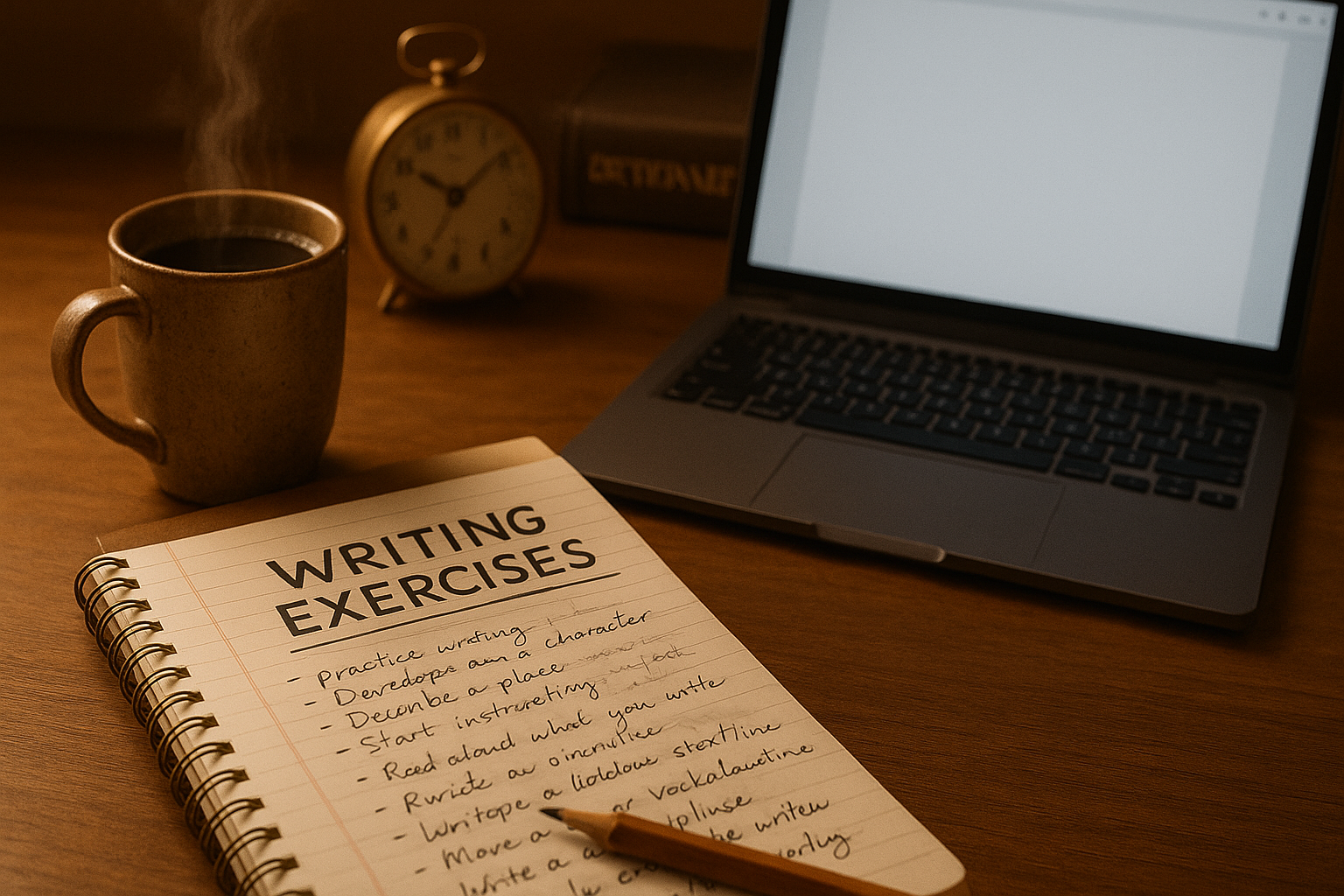
Ever stared at a blank page for so long that you swear it’s mocking you?
Yeah, we writers all know that feeling.
Let’s be real: writing skills get rusty when you don’t use them regularly. Just like that gym membership you keep paying for but rarely use.
These 10 quick writing exercises are your express workout for flabby prose. In just 10 minutes a day, you’ll sharpen your writing skills without the intimidation of committing to a full-length project.
I’ve tested these with hundreds of struggling writers who swore they couldn’t string two decent sentences together.
Wait until you see what happened to their writing after just one week of these exercises.
Freewriting: Unleash Your Creativity
Set a timer for 5 minutes
Ever notice how your best ideas come when you’re not trying so hard?
Freewriting harnesses that phenomenon. First things first: grab your phone and set a timer for 5 minutes.
That’s it—just 5 minutes. Not long enough to get bored, but enough time to tap into your creative well.
The beauty of this time constraint is that it tricks your brain into focusing. When you know the clock is ticking, your inner editor takes a backseat.
Five minutes feels manageable even on your busiest days, making this exercise perfect for fitting into morning routines or lunch breaks.
Write without stopping
Once that timer starts, your only job is to keep your pen moving or fingers typing. No pausing. No second-guessing. No backspacing.
If you get stuck, simply write “I’m stuck” until something else flows. Write whatever pops into your mind—random thoughts, observations, fragments, nonsense—it doesn’t matter. The goal isn’t perfect prose; it’s continuous movement.
This uninterrupted flow bypasses your critical brain and connects you directly to your subconscious, where your most original ideas live.
Embrace imperfection
Your freewriting will look messy. It’ll have spelling errors. Sentences might not make sense. That’s not just okay—it’s the point!
Think of freewriting as your creativity gym. You’re building muscles, not creating a masterpiece. Some days you’ll write pure gibberish. Other days, you’ll uncover brilliant ideas hiding in the chaos. Both outcomes are wins because you’re training your brain to generate ideas without judgment.
The magic happens when you review your freewriting later and find unexpected gems worth developing.
Word Association: Expand Your Vocabulary
A. Choose a random word
Grab a dictionary, flip to a random page, and point. Or use an online random word generator. The goal is to find a word that’s not already at the tip of your tongue.
The more unfamiliar, the better! This exercise works wonders when you pick words outside your comfort zone. Try nouns, verbs, or adjectives that make you think, “Hmm, I don’t use that much.”
B. List related words quickly
Set a timer for two minutes. Write down every word that comes to mind when you think of your chosen word. Don’t censor yourself or overthink it. If you picked “ocean,” your list might include “waves,” “salt,” “blue,” “deep,” but also less obvious connections like “mystery,” “unexplored,” or “pressure.” The magic happens when you push past the obvious associations to discover unexpected links.
C. Create sentences using new connections
Now for the fun part. Pick three word connections that surprise you the most and craft a sentence for each. These aren’t just random sentences—they’re bridges between concepts your brain doesn’t usually connect.
This trains your mind to find fresh metaphors and unique descriptive angles. If you connected “ocean” with “ceiling,” you might write: “The office ceiling rippled like an ocean above her desk, its popcorn texture forming white-capped waves in the fluorescent light.”
Try this daily with different starting words. Your vocabulary muscles will thank you, and you’ll start noticing your writing becoming more vivid and unexpected.
Dialogue Writing: Master Conversations
A. Craft a two-character exchange
Noticed how some dialogue in books feels real while others fall flat?
The secret lies in creating authentic conversations.
Take 10 minutes to write a short dialogue between two characters. Pick a simple scenario – maybe two friends deciding where to eat or strangers stuck in an elevator. Don’t overthink it. Just let them talk to each other naturally.
Try this: Give each character a distinct voice. Maybe one speaks in short sentences while the other rambles. One uses slang while the other is more formal. These little differences make your characters jump off the page.
B. Focus on natural speech patterns
Nobody actually talks in perfect sentences. Real people use fragments, interrupt themselves, and trail off mid-thought. When you’re writing your dialogue, read it aloud. Does it sound like something you’d actually hear someone say?
Drop unnecessary words.
Cut the “well” and “um” unless they serve a purpose. And remember – people rarely use each other’s names repeatedly in conversation. That’s a dead giveaway of amateur dialogue writing.
C. Convey emotions through words
Great dialogue does double duty – it moves the story forward while revealing character emotions. Instead of writing “he said angrily,” show that anger through word choice and sentence structure.
Compare these:
“I don’t want to talk about it,” she said sadly.
“I don’t… just leave it alone, okay?” She turned away, shoulders tight.
The second example shows the emotion without telling it. You can practice this right now – take a basic exchange and rewrite it three different ways to convey three different emotions. Same words, different feeling. Your readers will thank you for it.
Descriptive Writing: Paint with Words
A. Select an everyday object
Grab that pen, coffee mug, or houseplant sitting nearby.
Ordinary objects make perfect subjects for descriptive writing because they force you to look beyond the obvious. Don’t overthink it—the simpler the object, the more you’ll stretch your descriptive muscles trying to make it interesting. That old phone charger? Suddenly it’s not just a tangled cord but a lifeline connecting you to your digital world.
B. Use all five senses
Don’t just tell readers what your object looks like.
How does it feel against your skin? Smooth, rough, heavy, light? What sound does it make when you tap it? Does it have a scent?
While you probably shouldn’t lick your keyboard, you can imagine its taste or associate it with flavors.
When you engage all five senses, your descriptions leap off the page and plant themselves firmly in your reader’s imagination.
C. Avoid clichés
Skip the “soft as silk” and “cold as ice” descriptions that readers have seen a thousand times. Challenge yourself to create fresh comparisons. Instead of “white as snow,” try “white as the pages of an unread book.”
Your unique perspective is what makes descriptive writing valuable.
The more unexpected your descriptions, the more your readers will remember them. Push yourself to find connections nobody else would make—that’s where the magic happens in descriptive writing.
Sentence Variation: Add Rhythm to Your Prose
A. Write five sentences about one topic
It gets boring when all your sentences sound the same. Isn’t it?
Monotony kills your reader’s interest faster than a lecture on paint drying. Grab a timer, set it for two minutes, and write exactly five sentences about anything you want—your morning coffee, your pet, or even that weird dream you had last night.
Don’t overthink it. Just get those five sentences down and move on to the next step.
B. Vary sentence length and structure
Now comes the fun part—shake things up!
Take those five sentences and rewrite them with dramatic variation. Start with a punchy, short one. Follow it with a longer, more flowing sentence that carries your reader through several connected thoughts, perhaps using commas to create rhythm and momentum as you build your description. Then mix in questions?
Try an exclamation for emphasis! End with something profound but simple. This variation creates a natural cadence that keeps readers hooked and prevents your writing from becoming predictable.
C. Read aloud to check flow
The secret weapon of professional writers? Their ears. Reading your work aloud instantly reveals awkward phrasing, repetitive sounds, or clunky transitions your eyes might miss on screen. Stand up, project your voice, and really perform your sentences.
Feel where you naturally pause or stumble—those are the spots that need fixing. Notice how your breathing changes with different sentence lengths? That’s exactly what happens to your readers mentally as they process your words. When your writing sounds good to your ear, it’ll feel good to your reader’s brain.
This ten-minute exercise trains you to instinctively vary your rhythm like a pro.
Character Sketching: Bring People to Life
A. Observe a Stranger
Well, perfect strangers can spark your imagination too!
Next time you are in a coffee shop, park, or waiting in line, pick someone you don’t know and really look at them. What makes them unique?
Maybe it’s how they tilt their head when they talk or the way they fidget with their keys. Spend five minutes noting these details – not in a creepy way, just as a writer collecting human moments.
B. Describe Physical Appearance
Now get those observations on paper.
Don’t just write “blue eyes” or “tall” – anyone can do that. Dig deeper. Is their posture confident or do they shrink into themselves? Do their hands look like they’ve worked outdoors for decades? Are their eyes constantly scanning the room? You’re painting a picture with words, so make every detail count. Give yourself just two minutes to capture what makes this person visually memorable.
C. Imagine Their Backstory
This is where the real fun begins. Based on what you’ve observed, create a quick life story. Where did they grow up? What job do they have? What secret might they be keeping? Your brain naturally fills these gaps – it’s what makes you a storyteller. Take one minute to jot down 3-5 key elements of their imagined life.
D. Write a Brief Monologue
For your final two minutes, become this person. Write 4-6 lines as if they’re speaking directly to someone else. Maybe it’s a confession, a complaint, or a moment of joy. Use their imagined vocabulary and speech patterns. This exercise trains you to hear different voices in your head (the good kind of voices, promise). The monologue doesn’t need to be perfect – just authentic to the character you’ve created.
Metaphor Creation: Enhance Your Imagery
A. Choose an abstract concept
Metaphors have the power to transform your writing from bland to brilliant in seconds. To get started, pick an abstract concept that might be tough to describe directly—something like love, freedom, depression, or creativity. The less tangible, the better! You’re looking for ideas that readers can’t touch or see but definitely feel or experience. Time, hope, or anxiety work perfectly here. Jot down a concept that interests you or relates to your current writing project.
B. Compare it to something tangible
Connect your abstract concept to something physical and concrete. If creativity is your chosen concept, you might compare it to a river—sometimes flowing freely, other times dammed up or running dry. Or maybe anxiety feels like a swarm of bees buzzing in your chest. The more unexpected your comparison, the more your readers will sit up and pay attention. Don’t go for the obvious—push yourself to find connections that surprise.
C. Extend the metaphor
Don’t stop at a simple comparison! Flesh out your metaphor by exploring additional connections. If you’ve compared depression to quicksand, dig deeper: How does it pull you down? What struggles happen when trying to escape? What does the surrounding landscape look like? The most powerful metaphors work on multiple levels. Take a full minute to explore at least three ways your comparison works, writing a sentence for each connection. This exercise trains your brain to think symbolically, giving your writing depth that sticks with readers long after they’ve finished your piece.
Perspective Shifting: Broaden Your Viewpoint
A. Rewrite a familiar story
Want to break out of a writing rut?
Try seeing a familiar tale through fresh eyes. Pick a story everyone knows – a fairy tale, a movie plot, or even a personal anecdote – and completely flip it on its head. What if Cinderella was actually relieved to leave the ball at midnight? What if the Three Little Pigs were actually the antagonists?
Give yourself 10 minutes to quickly draft an alternative version. This exercise forces you to question assumptions and discover new narrative possibilities hiding in plain sight. You’ll be amazed how quickly this unlocks creativity you didn’t know you had.
B. Change the narrator
Who’s telling your story matters more than you think. Take a scene you’ve written (or grab a page from your favorite book) and rewrite it from a different character’s viewpoint.
The coffee shop argument between lovers? Try it from the barista’s perspective. The epic battle scene? Narrate it through the eyes of a scared child watching from afar.
This quick perspective shift reveals how the same events feel dramatically different depending on who’s experiencing them. Your characters will instantly gain depth, and you’ll develop that crucial skill of inhabiting different mindsets.
C. Explore different emotions
Emotional range separates good writing from great writing. For this 10-minute exercise, take a basic scenario (waiting for a bus, making dinner, a job interview) and write it three times, each with a dominant emotion.
First write it with underlying excitement, then with simmering anger, finally with profound grief. Don’t explicitly name the emotions – show them through sensory details, internal thoughts, and physical reactions.
This practice helps you move beyond your comfort zone and create authentic emotional landscapes in your writing. Soon you’ll naturally infuse your work with the full spectrum of human feeling.
Hone Your Concision
Read a long article
Like this one and share your views in the comments, that’s writing practice too.
Summarization is your lifesaver.
You can pick an article that would normally take you 15 minutes to read. It could be from The New Yorker, The Atlantic, or even a lengthy LinkedIn post. Your job isn’t to read it casually—you need to hunt for the core message.
Distill main points
Now comes the tricky part. What’s actually important in all those paragraphs? Look for:
- The central argument or thesis
- Key supporting evidence
- Notable quotes or statistics
- Any counterarguments presented
- The conclusion or call to action
Jot down these in bullet points. Don’t worry about pretty sentences yet—focus on capturing the essence.
Rewrite in 50 words or less
This is where the real magic happens. Take those bullet points and craft a mini-masterpiece of brevity. Fifty words isn’t much—about three tweets’ worth. You’ll need to be ruthless with your editing:
- Cut redundant phrases
- Remove descriptive fluff
- Combine related ideas
- Use strong, precise verbs
- Prioritize what truly matters
When you are done, read it aloud. Does it capture what’s important? Would someone who hasn’t read the original get the gist? You’ve just flexed your summarization muscles—one of the most valuable skills in today’s information-packed world.
Edit and Refine: Polish Your Work
A. Choose a previous writing sample
Ever looked back at something you wrote and cringed? That’s good. It means you’re growing. Grab a piece you wrote a few weeks or months ago—a blog post, email, short story, or even a social media caption. This exercise works best with something you haven’t looked at in a while, so your eyes are fresh.
B. Cut unnecessary words
Time to be ruthless. Go through your sample line by line and cut:
- Redundant phrases (“completely finished” → “finished”)
- Empty modifiers (“really,” “very,” “quite”)
- Wordy constructions (“in order to” → “to”)
Challenge yourself: Can you trim 10% of your word count without losing meaning? The tighter your writing, the more punch it packs. Remember how Stephen King says “kill your darlings”? He’s right.
C. Strengthen verb choices
Weak verbs drain your writing’s energy. Spot verbs like “is,” “was,” “had,” and “went.” Replace them with something specific and vivid:
- “She walked to the store” → “She trudged to the store”
- “He was angry” → “He fumed”
This simple swap instantly elevates your writing from amateur to compelling.
D. Clarify unclear phrases
Read your piece aloud. Stumble over anything? That’s your clue something needs fixing. Look for:
- Vague pronouns (which “it” are you referring to?)
- Ambiguous references
- Jumbled sentences that try to say too much
Rewrite confusing sections until they’re crystal clear. If you have to read it twice to understand, so will your readers.
Practicing these ten quick writing exercises can transform your writing abilities with minimal time investment.
By dedicating just ten minutes daily to freewriting, word association, dialogue practice, descriptive writing, sentence variation, character sketching, metaphor creation, perspective shifting, summarization, and editing, you’ll develop a more versatile, confident writing style.
Remember that consistency matters more than duration.
Even when life gets busy, these bite-sized exercises fit into any schedule. S
tart implementing these writing techniques tomorrow and watch your writing grow sharper, more expressive, and more engaging.
Your future readers will thank you for the effort you’ve put into crafting clear, compelling content that truly resonates.
Leave a Reply